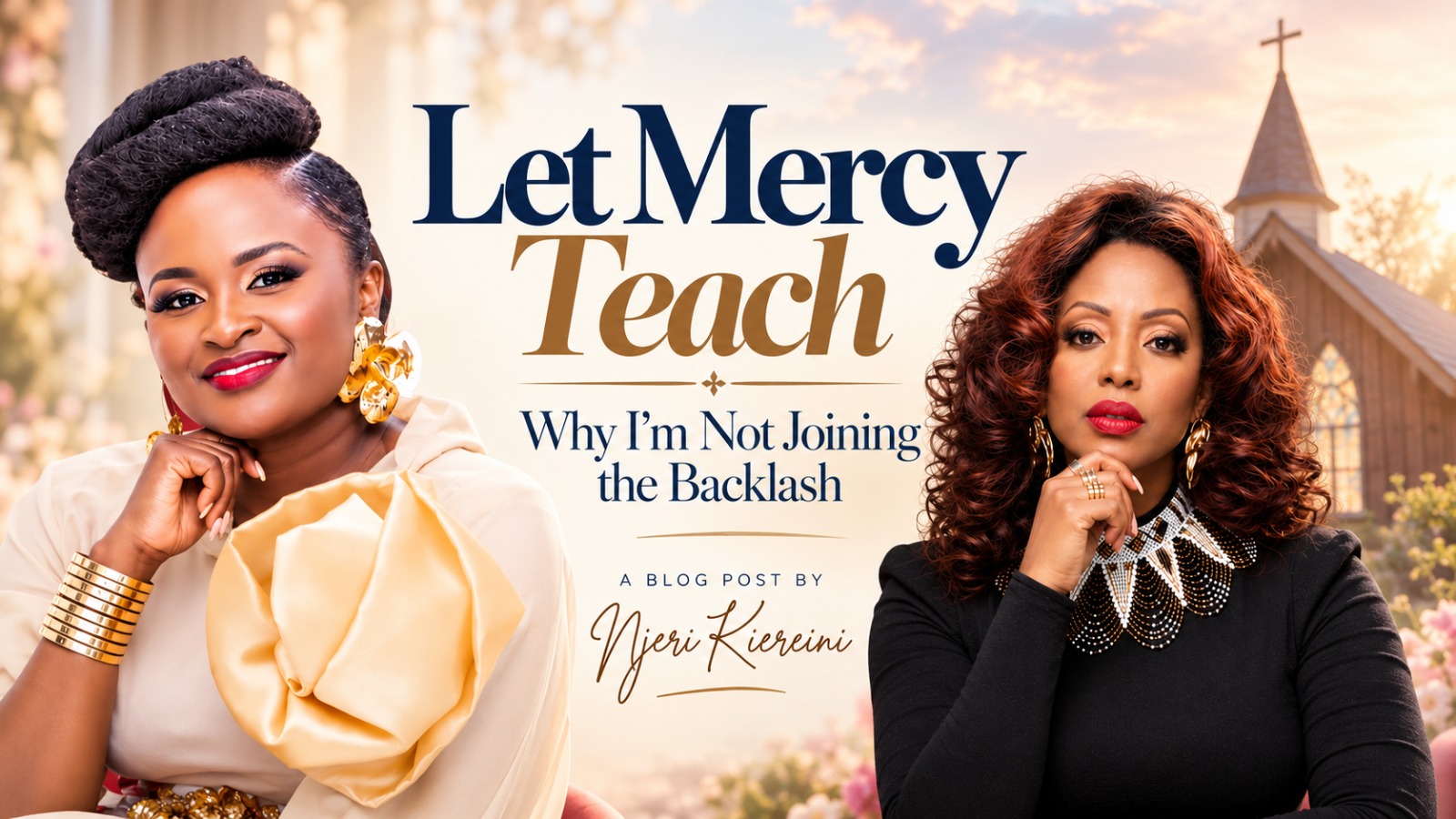
When I first saw the reaction to Mercy Masika’s Becoming a Wife masterclass, my instinct was to come out swinging in her defence. I have since sat with it. I still stand with her. But I want to do it the way I would want any woman to be engaged with: by listening first.
Rev. Mercy Masika has been married to one man for about 18 years, and she has been honest about how hard the early years were. Her seven-session online class runs from 21 November to 12 December, with Lady Bishop Kathy Kiuna as a guest. She says it is for women who believe marriage shouldn’t be miserable.
And she is a reverend. What is the role of a reverend, if not to guide her flock by the scriptures she believes in? She is speaking to women of the Christian faith who still believe in the church and in marriage as God designed it. That is not overreach. That is her job. I do the same in my role as a coach: I teach what I have seen work in the lives of the women I walk with. Why shouldn’t she do the same as a reverend?
If her framework is not for you, you are free to pass. But I do want to ask: why have so many come out with guns blazing at a woman simply doing what her calling asks of her?
Which room are we reading?
The loudest critique came from Janet Mbugua, and I respect her. On Instagram she wrote of “a masterclass on marriage but mute on the injustice and violence around us.” She named femicide, sexual abuse and missing children, and asked the church to use its platform for justice.
Those are real issues, and they deserve our anger and our action. But they are not what Mercy’s class is about, and one does not cancel the other. A church can run a marriage class and still stand against violence. We are asked to read the room. Mercy has read hers. Her room is women of faith who have chosen marriage, or hope to, and want to do it well. That room has nothing to do with Janet’s beliefs, or mine, or anyone else’s. We each have to pick our battles, and this one is not the enemy.
Others have pushed back too. Catherine Kamau, known as Kate Actress, reminded us that marriage is beautiful but is not a woman’s only aspiration. I agree. But a class on one aspiration is not a claim that it is the only one.
What about the men?
The question I hear most is fair: “Becoming a wife to who? Where is the class for husbands?” DJ Xclusive answered it with humour, announcing a husbands’ masterclass of his own on 26 October. I hope he follows through. Men need this work as much as women do.
Author Jacob Aliet took the question in a different direction. Responding to Janet’s critique in a video, he argued that our marriage conversations cast women as victims and men as perpetrators, and leave men’s suffering out of the picture. He named emotional abuse, financial exploitation and sexual rejection inside marriage. He pointed out that the church teaches sacrificial love mostly to men, while women are educated and empowered for careers but rarely prepared for marriage. His conclusion: train both. Teach men to be better husbands and women to be better wives.
I don’t agree with everything Jacob says, but on that last point we stand together. Mutual responsibility is the whole point. And the answer to a missing class for men is to build one, not to tear down the class for women.
What my women told me
This year I ran a series of masterclasses for women. It began with Love Again But Wiser, on choosing better after a relationship ends. Then came Out of Whack, on ending well. Radical Detachment was about caring without carrying. How to Be a Low-Maintenance Woman was about asking for what you need clearly. Chemistry or Conditioning went deep into attachment.
In that first session we talked about divorce, and about long relationships where people lived together for years and then parted. I told the women what I believe: there is little difference. The legal battle may differ, but the impact on the heart, the mind and how you see each other is the same. The end of a long relationship is a nervous system event. It is an identity event. It is not about poor judgment. It is about transition.
After each session I asked for feedback, and 37 women answered across four sessions.
Eight of the 14 women at Love Again But Wiser said the session significantly changed how they see love and endings. Not one said it made no difference.
Their biggest insights were about themselves, not about men: “Knowing I’m an avoidant.” “The type of men I attract.” “Just knowing I’m not alone after separation.”
At Out of Whack, the moments that stood out were “leaving with dignity” and learning “how to end well.”
At Chemistry or Conditioning, 14 of 17 rated it 5 out of 5 for relevance to their season of life. Every woman asked said she wanted to go deeper. The topic they wanted most next was relationship repair, so their relationships would last.
These are women who have been hurt, and they are still choosing love. If they had given up on relationships, they would not have logged on at 8 pm on a weeknight and stayed to fill in a form. They want partnership. Many still want marriage. What they want most is someone willing to show them how to do it wiser.
The advice we already accept
Look at what passes for relationship advice today. If he doesn’t give you this, he’s not the one. Do this so you can get that. Love has been reduced to a trade.
In that trade, the man must always be ready to provide. He is buying something. And the woman? She just has to be pretty, nice and organised. Nobody calls that outdated. Nobody asks where her class is.
There is something else I’ve noticed. Much of the conversation out there quietly places women on higher moral ground than men. I want to know what that is based on. Our past experiences? A belief that we have done better than our mothers? Anger at our fathers, or at the men who have passed through our lives?
We spend a lot of time talking about men. How often do we sit with ourselves? When last did we ask what we bring, what we withhold, and what we expect without giving? Mercy is inviting women to do exactly that. She is not claiming her way is the only right way. She is saying: here is the biblical framework, let’s try it, it might actually work for us. That is not an insult. It is an offer. And to the women shouting the loudest, I would gently say: before we point at Mercy, let’s take a long, honest look at ourselves.
A wife is still a role worth learning
In my years of coaching women, one struggle comes up again and again: vulnerability. We find it hard to ask for help. We find it hard to say “I don’t know” or “I can’t do this alone.” We have been taught to be strong and self-sufficient, and we have learned the lesson well.
But then what is companionship for, if not to meet those very needs? A marriage where neither person can be soft is two people sharing a roof.
This is why self-knowledge matters so much. You cannot be a good wife, friend, colleague or sister if you do not know your own patterns. My women came looking for that self-knowledge, and they found it. Mercy’s class takes the next step. It asks: now that you know yourself, how do you show up in the role of a wife?
This year I also taught a session called How to Be a Low-Maintenance Woman. I know how that title sounds. I was not asking them to be silent or to have fewer needs. A woman with no clear needs is actually high maintenance, because the man beside her is always guessing. I was teaching them to say “I feel this, I need this” calmly and clearly, instead of hinting or flooding him with voice notes. Men often withdraw not because they don’t care, but because they keep trying and keep failing. Clarity gives both people a way to win.
That is wife training, if you like. It is also friend training, colleague training and sister training. Learning it does not make a woman smaller. It makes her understood.
I see no harm in that. The role exists. Women are still choosing it, every year, in churches and in registry offices across this country. Teaching them to do it well is not oppression. It is care.
The generations are pulling in different directions. Many Gen Z women are asking whether relationships are worth it at all. Many millennials are unmarried and still hoping. Both groups deserve more than slogans. They deserve frameworks, and Mercy is offering one.
So, let Mercy teach
Some have said the timing is wrong. I think it is spot on. We are heading into 2027, and this is the season when people step back, look at the year behind them and ask what they want to change. If someone wants a better relationship as part of living a better life next year, now is exactly the time to start.
I also take the backlash as a positive. Mercy has put a topic on the table that clearly needed to be there, whether you agree with her or not. The reaction has uncovered how many of us really feel about the institution called marriage.
And that is where the real tragedy lies. The more we discredit marriage, the harder it will be to raise the next generation. A father and a mother each have a role in raising a child. If we truly care about our children, we should pay attention to what Mercy is saying.
We also need to be honest about something else. For one reason or another, the single life has come to look preferable to commitment. But are we acknowledging how brutal loneliness is? Sometimes we look for causes to fill that space and to justify the choices we have made. Maybe we simply need to admit that we are lonely, and that companionship is good. In my coaching I have seen it again and again: at some point, people desire it. For some it is a quiet ache nobody wants to name. Bottom line, we do not like being vulnerable.
At United Women’s Council, that is part of our mission in 2027. Through Love Again But Wiser, we will keep building self-awareness and keep challenging the narratives quietly running the show in the background, to see whether they are really serving us.
So, let Mercy teach.
Sources:
Submit harder? Janet Mbugua challenges Mercy Masika’s marriage masterclass, K24 Digital, 25 Oct 2026
Men kindly assemble: DJ Xclusive launches husband masterclass, K24 Digital, 26 Oct 2026
Mercy Masika’s becoming a wife masterclass sparks debate, K24 Digital, 24 Oct 2026
Jacob Aliet, video response to Janet Mbugua
Unlock Your Worth series: Love Again But Wiser, Chemistry or Conditioning, Out of Whack, Radical Detachment (2026)
About the Author
Njeri Kiereini
Njeri Kiereini is a social systems thinker, mental health advocate, researcher, and coach whose work sits at the intersection of emotional wellbeing, effective parenting, family systems, and social transformation. She is the Founder and CEO of the United Women’s Council (UWC) — a platform built on the conviction that a whole woman makes a whole family, and a whole family makes a whole community. She is also the host of Boomerang Podcast Africa. Drawing on experience across advocacy, community development, financial services, and leadership, Njeri works with individuals, families, and institutions to understand the deeper patterns that shape human behaviour and societal outcomes. She is the convener of the Parenting Through the Milestones Summit, which in 2026 brought together over 150 parents across four sessions to ask the hardest questions about raising children in modern Kenya. She is currently pursuing a Master’s degree in Social Transformation and is a frequent speaker and facilitator on emotional wellness, parenting, relationships, leadership, and social change.
Whole Woman. Whole Life. Strength and Grace.
