A reflection on what happened in a Nairobi courtroom on July 1, 2026
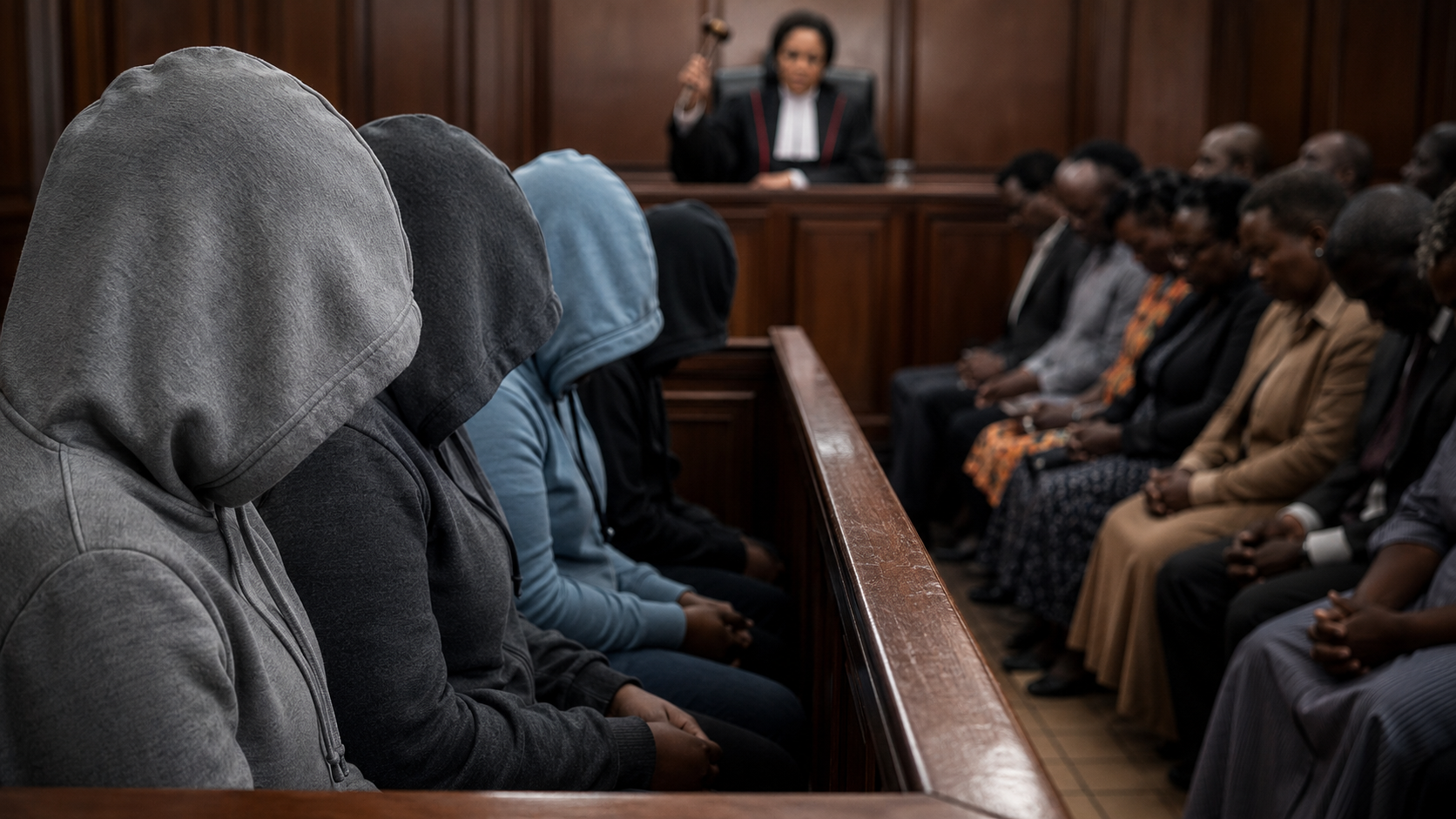
On Wednesday, July 1, 2026, eight teenagers walked into the Kibera High Court with their faces covered — hoods and masks, identities sealed by court order. They stood before Justice Diana Kavedza. The charges were read. Sixteen counts of murder. One for each girl who died at Utumishi Girls Academy on the night of May 27 and 28.
Each of them said: not guilty.
And then Justice Kavedza said something that I have not been able to stop thinking about since.
She told the court, the prosecution, the defence, and the media present that these eight teenagers were not to be referred to as suspects. Not as accused persons. Not by name, initials, photographs, voice recordings, school admission numbers, or physical descriptions. They were to be referred to, throughout the entire proceedings, only as subject minors.
“The subject minors are charged with murder,” she said.
Two words. A legal designation. And yet those two words carry an entire philosophy of justice inside them.
A suspect is someone we have not yet proven guilty. An accused is someone we have charged. But a subject minor is something different again. It names, simultaneously, two truths that the law is usually clumsy about holding at once: that this person is subject to the full weight of the law — sixteen counts of murder is as serious as the law gets — and that this person is a minor, a child, not yet finished, still developing, still, in the eyes of both science and the Children’s Act, someone whose identity should not be foreclosed by a single act, however catastrophic.
Justice Kavedza went further. She ordered the proceedings to be conducted using a child-sensitive and trauma-informed approach. She directed children’s officers to be positioned around the dock. She ordered that no television or social media access be permitted at Kabete Juvenile Remand Home, where the eight girls are being held, after reports that they were being subjected to online bullying and harassment. She ordered six months of counselling. She directed their parents to provide sanitary towels, tissue paper, toothpaste, and soap — because the remand facility, she noted, was under strain.
“This is not an ordinary criminal trial,” she said. “It concerns children.”
Three psychiatrists from Mathari National Teaching and Referral Hospital had already assessed each of the eight, separately, and concluded they were mentally fit to stand trial. The DPP assigned two of its most experienced homicide prosecutors to the case. The court warned against trial by media, against public pressure, against premature conclusions. It ordered a confidential register, accessible only to parties involved. It cautioned journalists explicitly: “Do not try to unveil the child. The child belongs to the court.”
I wrote, in the third essay of this Utumishi series, about a courtroom moment I witnessed almost a decade ago — children handcuffed in single file, no expression on their faces, charged with killing a neighbour’s son. I said I had carried that image for years without being able to fully put it down. That I kept asking myself what had happened in their lives before that day, and what was supposed to happen that did not.
I wrote about restorative justice as a question — whether Kenya had the frameworks, the will, and the imagination to ask not only what punishment fits the crime, but what process could actually return a broken young person to the community as something other than a threat.
What I did not expect was that the court itself would be asking that question before the ink was dry.
Because what Justice Kavedza did on July 1 was not simply a procedural protection of juvenile defendants. It was an act of philosophical precision. She looked at eight sixteen-year-olds facing the most serious charges in Kenyan law and said, in effect: we will hold these children fully accountable, and we will not pretend, while doing so, that they are not children. Both things. At once. Not one softening the other. Both.
That is exactly what restorative justice asks for — not the absence of consequence, but the presence of a justice system mature enough to hold accountability and humanity in the same hand.
There is one more detail from the courtroom that deserves to be named.
The remand facility is under strain. The parents were asked to bring soap.
I sat with that for a long time.
Sixteen girls are dead. Sixteen families are in grief that has no bottom. The families of the eight subject minors are carrying something that also has no name in ordinary language — the particular weight of loving a child who did something that cannot be undone. The remand home is overcrowded. The court is ordering counselling while simultaneously trying to manage sixteen murder charges. The state is doing, all at once, what it was never designed to do alone.
This is what downstream looks like. This is the repair shop at the end of the chain — the most expensive, most coercive, least effective intervention of all — doing its best, under strain, with soap that the parents have to bring from home.
I am not writing this to say the eight subject minors should go free. I am not writing it to minimise what happened to the sixteen girls who died, or to the seventy-nine who were injured, or to every parent and sibling and friend who will carry May 28 for the rest of their lives.
I am writing it because Justice Diana Kavedza — in a courtroom in Kibera, on a Wednesday morning, in a case that the whole country was watching — modelled something that the rest of us, as parents, educators, community leaders, and institutions, are supposed to be doing much, much earlier than the courtroom.
She held two truths at once. She did not let the gravity of the charge erase the humanity of the child. She did not let the protection of the child erase the gravity of the charge.
Subject minors. Held fully accountable. Still recognised as children.
That is not a legal technicality. That is the posture every adult in a child’s life is supposed to take — from the moment the child is born, not the moment they stand in a dock.
The tragedy of Utumishi is not only that sixteen girls died. It is that the courtroom is now being asked to do what the family, the school, the community, and the state should have done years ago — hold these children in both hands at once. Firmly. And with care.
The child belongs to the court.
But long before the court — the child belonged to all of us.
Sources: Daily Nation, The Standard, AllAfrica
About the Author
Njeri Kiereini
Njeri Kiereini is a social systems thinker, mental health advocate, researcher, and coach whose work sits at the intersection of emotional wellbeing, effective parenting, family systems, and social transformation. She is the Founder of the United Women’s Council (UWC) — a platform built on the conviction that a whole woman makes a whole family, and a whole family makes a whole community. Drawing on experience across advocacy, community development, financial services, and leadership, Njeri works with individuals, families, and institutions to understand the deeper patterns that shape human behaviour and societal outcomes. She is the convener of the Parenting Through the Milestones Summit, which in 2026 brought together over 150 parents across four sessions to ask the hardest questions about raising children in modern Kenya. She is currently pursuing a Master’s degree in Social Transformation and is a frequent speaker and facilitator on emotional wellness, parenting, relationships, leadership, and social change.
Whole Woman. Whole Life. Strength and Grace.