In Part One, we told the story of what burned — and what it took sixty years to build. In this part, we ask why. Not why in the legal sense. Why in the human sense.
The First Institution
There is a principle that those who work in child development understand well, even if our public conversations rarely reflect it: the family is the first institution. It is not one institution among many. It is the institution upon which all others depend.
When family functions well, children arrive at school already formed in the basics — able to sit with frustration, to follow instructions, to relate to peers, to accept correction. Schools can then do what they are designed to do: educate.
When family fails — not through malice, but through depletion, absence, stress, or dysfunction — children arrive at school already carrying wounds that the school was never designed to heal. And so the school becomes a repair shop. It tries to do what the family could not. It rarely succeeds, because it was not built for that work, and because the damage runs deeper than any curriculum can reach.
Downstream of the school sits the correctional system. The youth rehabilitation centre. The court. The prison. Each institution, further down the chain, is trying to repair what was not formed earlier. Each one is more expensive, more coercive, and less effective than the one before it. And none of them can give back what was missing at the beginning.
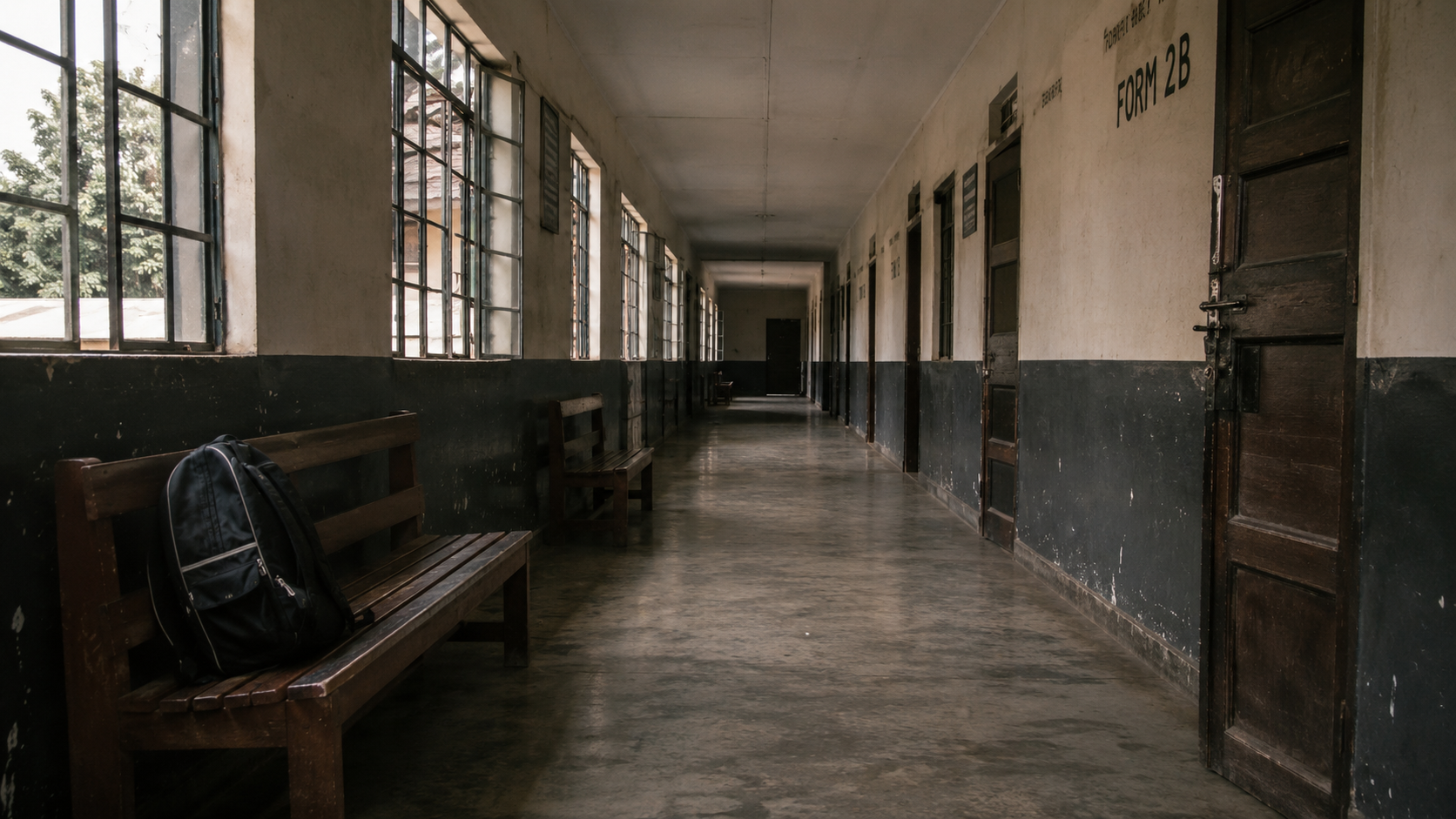
We are not facing a school problem. We are not facing a security problem. We are facing a family problem that has traveled downstream until it exploded in a dormitory in Gilgil at three in the morning.
The behavioral patterns that lead children toward destruction — what clinicians call conduct disorder, a mental health condition characterised by a persistent pattern of behaviour that violates the rights of others and major social rules: aggression toward people or animals, deliberate destruction of property, deceitfulness, theft, and serious rule violations — are not reversed in correctional facilities. They are interrupted earliest and most effectively in families, and secondarily in schools — through consistent relationships, clear boundaries, real consequences, and the steady presence of adults who hold a child accountable while never withdrawing their love. That is the intervention. Not detention alone. Not punishment alone. Relationship. Accountability. Presence.
And here is where faith communities — churches, mosques, temples — deserve to be named explicitly, because they are often left out of these conversations as though they are optional extras. They are not.
Religious institutions carry something that schools and governments cannot provide: a framework in which a young person is not merely a citizen, not merely a student, not merely a consumer — but a being with inherent dignity, embedded in a story larger than themselves. A child who understands that there is a higher power, that they did not create themselves, that they exist as part of a purpose and a design — that child has an anchor that the secular world cannot manufacture.
This is not simply about doctrine. It is about formation. It is about answering the deepest questions a young person asks: Who am I? Why do I matter? What am I here for? What holds me accountable when no one is watching?
When a young person understands that they are part of a larger whole — that humanity is an ecosystem with a moral order, that every life has a role to play, that their actions ripple outward in ways they cannot always see — they are less likely to act as though their frustration is the only thing that matters in the universe. They are less likely to set a mattress on fire over an exam schedule.
Faith communities are part of the institutional chain that forms young people. When they are vibrant, they provide exactly what developmental research says adolescents need: belonging, accountability, contribution, identity, and the affirmation that they will make it through difficult times. When they are absent — or when they become transactional, performance-oriented, or disconnected from real formation — that link in the chain breaks too.
There is one more structural failure worth naming here. When Kenya abolished corporal punishment in schools, it was the right decision. Physical punishment had been abused for decades — used not as correction but as humiliation, fear, and control. That past should not be romanticised.
But the removal of that tool was never matched with the building of a better structure. We did not replace caning with consistent restorative discipline. We did not replace it with properly trained counsellors, parental accountability frameworks, or early intervention systems. We removed a bad tool and filled the space with confusion. School heads today report that even when they make disciplinary decisions, the Ministry of Education frequently overturns them — leaving administrators without authority, students without consequences, and institutions without the credibility that order requires.
Fire has become a language. A language of anger, protest, imitation, and — in the worst cases — complete indifference to the lives of others. We did not create that language overnight.
The further downstream a child travels before intervention, the harder the work becomes. The Utumishi moment is very far downstream. We need to ask ourselves: where were the earlier moments? And what did we do with them?
Two Mistakes We Are Making at Once
The Utumishi tragedy sits at the intersection of two cultural failures happening simultaneously in Kenya.
The first is the failure of institutions — overcrowded dormitories, locked exits, safety standards that exist only on paper, and a pattern of impunity that stretches back to Kyanguli, where the convicted arsonist served only five years. When there are no real consequences, there is no real deterrence.
The second failure is subtler and more difficult to name. It lives in the character of the children themselves.
This is not a comfortable sentence. It is not an accusation against parents or a dismissal of systemic failures. It is an observation. Something is happening in the formation of young people — not just in Kenya, but across the world — that deserves serious attention.
We are raising children with remarkable emotional vocabulary. They can speak fluently about trauma, triggers, mental health, nervous systems, attachment styles, and boundaries. This is genuinely good. A generation that can name its pain is a generation capable of healing.
But naming is not the same as regulating. And explanation is not the same as accountability.
A child who once said “I was wrong” may now say “I was triggered.” A teenager who once said “I should not have done that” may now say “That’s just my trauma response.” The question is not whether trauma is real. It is. The question is whether we have inadvertently taught young people that understanding their behavior exempts them from responsibility for it.
A mature adult can hold both truths simultaneously: my experiences explain my behaviour, but they do not excuse it. That distinction — between explanation and excuse — may be one of the most important things we can teach a child.
The Pendulum We Swung Too Far
To understand how we got here, it helps to understand a shift that happened over several decades — not just in Kenya, but globally.
For much of the twentieth century, children were raised under conditions of excessive inhibition. Emotional expression was suppressed. Obedience was demanded without explanation. Anger was punished. Vulnerability was shamed. Children were seen but not heard, and many grew into adults who were fearful, emotionally constricted, unable to advocate for themselves, and unable to challenge authority even when that authority was wrong or abusive.
The psychological and therapeutic movements of the latter half of the century mounted a necessary correction. They gave people language for their inner lives. They helped individuals understand the origins of their patterns. They dismantled the culture of shaming that had caused so much damage. They validated emotions that had been suppressed for generations. This was important, healing work.
But every correction carries the risk of overcorrection.
We may now be living with the consequences of having swung the pendulum too far in the other direction — from excessive inhibition toward what psychologists call disinhibition: the weakening of the internal controls that govern behavior, regulate impulse, and mediate between feeling and action.
The healthy adult psyche contains a crucial function: the ability to stop. To pause between impulse and action. To ask: should I? To tolerate frustration without exploding. To delay gratification. To regulate anger before it becomes violence. To accept correction without collapsing or retaliating. To sit with consequences rather than escape them.
These are not repressive mechanisms. They are civilizational ones. They are what makes it possible for human beings to live together.
But somewhere in the shift from you must suppress everything to you must express everything, we may have lost the middle ground — which is not suppression and is not expression, but regulation. The capacity to feel fully and act wisely. The capacity to be angry without being destructive. The capacity to be frustrated without setting a mattress on fire.
Disinhibition does not announce itself. It arrives gradually, in small failures: a child who cannot accept a consequence, a teenager who cannot tolerate being told no, a young person who meets institutional frustration with the most catastrophic response available to them. The behavior at Utumishi did not emerge from nowhere. It emerged from a formation — or a failure of formation — that had been building long before the night of May 28.
The goal of raising emotionally healthy children was never to produce adults without restraint. It was to produce adults with self-restraint — people who govern themselves from the inside, not because they fear punishment, but because they have internalized the truth that their actions affect other human beings.
Conduct Disorder, Antisocial Behaviour — and the Deepest Irony of All
We have already named conduct disorder and what it looks like. But there is a dimension of it that demands its own conversation — not just the clinical pattern, but where it has appeared, and in whose children.
It is important to be clear: not every child who sets a fire has conduct disorder. Not every act of school arson is the endpoint of a clinical trajectory. Some acts emerge from poor judgment, peer pressure, panic, or a catastrophic failure of impulse control in a single moment. We do not yet know the full picture of what happened at Utumishi. But the pattern across Kenya — across decades — is not random. And it is worth asking: what are we doing, at the level of formation, to interrupt these trajectories early? What systems exist to identify children who are struggling before the struggle becomes catastrophic?
Now consider the irony.
The police exist to govern social conduct. Their entire mandate is to uphold the rules that hold a society together — to enforce consequences for those who violate the rights of others, to protect the social contract from those who would destroy it. Conduct. Order. Social regulation. These are not incidental to policing. They are its essence.
And now, in a school founded by a police officer, whose student body includes the children of police officers, children stand accused of the most extreme violation of social conduct imaginable — setting fire to a room full of sleeping peers. If the charges are proven, those children will potentially require the services of correctional institutions. Institutions that exist, in part, to address antisocial behaviour.
If the families of those who enforce social norms are themselves struggling to transmit those norms to the next generation — what does that tell us about the depth of the crisis we are in?
The officers who built this school, who send their children here, who wear uniforms that symbolise social order — their children may now encounter the correctional side of the very system their parents serve.
That is not a comfortable sentence. It is not written to shame anyone. It is written because the irony is too important to ignore. It raises a question that goes beyond Utumishi: if the families of those who enforce social norms are themselves struggling to transmit those norms to the next generation — what does that tell us about the depth of the crisis we are in?
They may be failing, where they are failing, because the institution that employs them has consumed them. Because stress travels home. Because exhaustion does not leave a person with much to give. Because the very system they serve has not adequately served them.
And their children are paying the price.
As may the children of those they are accused of harming.
What Adolescents Are Supposed to Be Learning — And What We Are Supposed to Be Giving Them
Developmental research on adolescence is clear about what this stage of life is for. From roughly thirteen onwards, a young person is supposed to be accomplishing a set of critical tasks — tasks that do not happen automatically, but require the active participation of family, community, and institution.
The adolescent is supposed to learn how to care for themselves and for others simultaneously — not one or the other, but both at once, in relationships that are genuinely mutual. They are supposed to develop the capacity to remain stable in difficult situations, and to know how to return themselves — and others — to a state of calm after distress.
They are supposed to bond with peers and develop a group identity — a sense of we, not just I. They are supposed to take responsibility for how their personal actions affect others, including protecting others from themselves when necessary. They are supposed to contribute to the community, to be able to say: this is who we are, and I am part of it. They are supposed to express the characteristics of their own heart in a deepening personal style — to become, in other words, themselves.
These tasks do not happen in a vacuum. They require something from the community in return.
The community is supposed to provide opportunities for young people to participate in group life — real participation, not performance. It is supposed to affirm adolescents: you will make it through difficult times. It is supposed to offer positive environments where peers bond around something constructive. It is supposed to teach young people that their behaviours affect others — and affect history. It is supposed to involve them in tasks that matter. It is supposed to hold them accountable while still accepting them — not one or the other, but both.
When those tasks are completed and that support is provided, something specific happens in a young person. They become other-oriented. Stable. Contributing. Capable of protecting rather than harming.
When they are not completed — when family is absent, community is fragmented, and institutions are depleted — something else happens instead. The child becomes self-centred, leaving others dissatisfied and frustrated. They conform to peer pressure and participate in negative and destructive group activities. They become isolated, or perform an exaggerated version of themselves. They become controlling, blaming, harmful — unable to protect others because they are not yet fully formed themselves. They do not become life-giving contributors to the community. They drain it. They are driven to prove themselves, to seek approval, to play roles — because no one ever told them, consistently, that they were already enough.
This is not a description of evil children. It is a description of unfinished ones. Children who needed something they did not receive.
The question Utumishi asks is not only: what did these children do? It is: what did they need, that was not there?
Part Three — Utumishi: What We Owe the Children Afterward — publishes next.
Sources: RSIS International Journal (2025), ResearchGate — Journal of Psychological Well-Being and Job Satisfaction of Kenyan Police Officers, Kenya Secondary Schools Heads Association, Ministry of Education Kenya
About the Author
Njeri Kiereini
Njeri Kiereini is a social systems thinker, mental health advocate, researcher, and coach whose work sits at the intersection of emotional wellbeing, effective parenting, family systems, and social transformation. She is the Founder of the United Women’s Council (UWC) — a platform built on the conviction that a whole woman makes a whole family, and a whole family makes a whole community. Drawing on experience across advocacy, community development, financial services, and leadership, Njeri works with individuals, families, and institutions to understand the deeper patterns that shape human behaviour and societal outcomes. She is the convener of the Parenting Through the Milestones Summit, which in 2026 brought together over 150 parents across four sessions to ask the hardest questions about raising children in modern Kenya. She is currently pursuing a Master’s degree in Social Transformation and is a frequent speaker and facilitator on emotional wellness, parenting, relationships, leadership, and social change.
Whole Woman. Whole Life. Strength and Grace.